
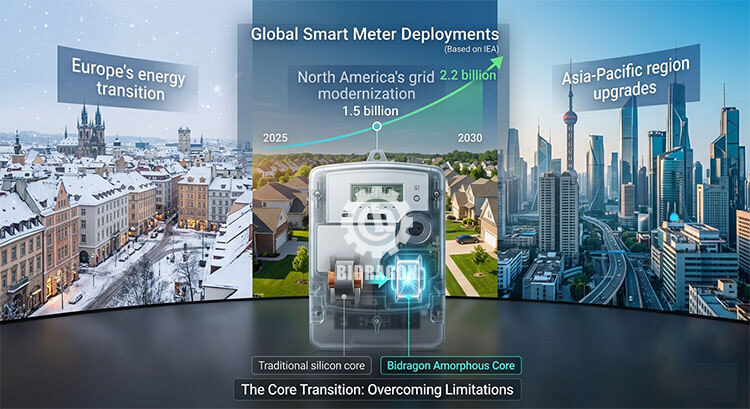
Over the past five years, the global smart meter market has been undergoing a quiet technological transformation. According to data from the International Energy Agency (IEA), global smart meter deployments surpassed 1.5 billion units by 2025 and are projected to exceed 2.2 billion units by 2030.
Whether in the context of Europe's energy transition, North America's grid modernization, or infrastructure upgrades across the Asia-Pacific region, virtually every market is raising its technical requirements for smart meters. Measurement accuracy, long-term reliability, energy efficiency levels, and environmental adaptability have emerged as the core criteria guiding product selection for utility companies worldwide.
This industry-wide shift is now rippling upstream through the supply chain. As the critical component within current transformers, the performance of the magnetic core directly dictates the overall performance of the electricity meter. Traditional silicon steel cores—a staple technology for nearly a century—are gradually revealing their limitations in the face of these new market demands. In contrast, amorphous cores are rapidly displacing silicon steel to become the mainstream technological solution for the next generation of smart meters globally.
Global energy efficiency regulations are becoming increasingly stringent, serving as the primary force driving technological upgrades in electricity meters. The EU’s Energy Efficiency Directive mandates the installation of smart meters in all new residential and commercial buildings, while explicitly establishing minimum energy efficiency standards for metering equipment. The U.S. Department of Energy has similarly updated its energy efficiency requirements for electricity meters, aiming to reduce grid metering losses by 15% by 2030.
Beyond regulatory mandates, the commercial imperatives of utility companies are also fueling this technological evolution. The development of smart grids necessitates meters capable of providing more precise and real-time consumption data to support demand-side response initiatives, the integration of distributed energy resources, and dynamic grid management. Concurrently, utility companies are striving to lower operational costs and minimize billing disputes—as well as "non-technical losses"—stemming from inaccurate metering.
Furthermore, the requirements regarding the service life of electricity meters are continuously rising. Most European nations now mandate that meters remain operational in the field for at least 15 years, while certain regions in North America have raised this standard even higher—to 20 years. This places unprecedented demands on the long-term stability and durability of these critical core components. Against this backdrop, the magnetic core is no longer merely a simple, generic component; rather, it has become a critical factor determining whether electricity meter products can gain entry into mainstream global markets.
The inherent physical properties of traditional silicon steel cores make it difficult for them to address the diverse challenges of the global market. These issues are prevalent worldwide, though the specific emphasis of their manifestation varies across different regions.
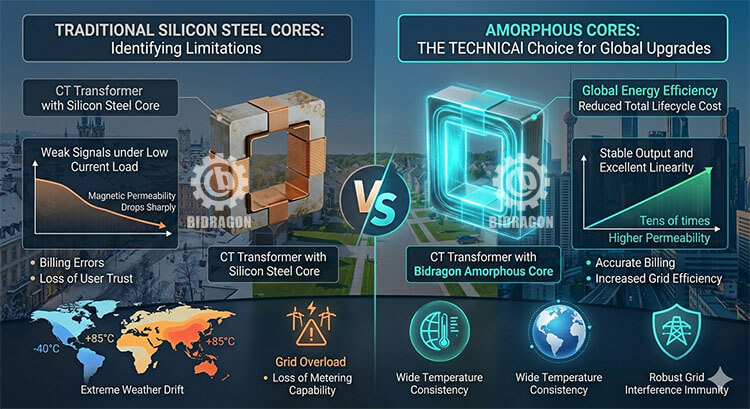
Inaccurate metering at low currents stands out as the most prominent and universal problem. Under low-load conditions, the magnetic permeability of silicon steel cores drops sharply; this results in weak output signals from current transformers, making them highly susceptible to noise interference. This not only leads to revenue losses for utility companies but also erodes user trust in the accuracy of their billing.
Problems associated with temperature drift—variations in performance due to temperature fluctuations—are particularly severe in regions with extreme climates. In environments characterized by the frigid winters of Northern Europe or the scorching summers of the Middle East, the magnetic properties of silicon steel cores undergo significant changes, causing metering errors to exceed permissible limits. Many products that pass rigorous testing in temperate climates frequently fail when deployed in such extreme environments.
Long-term operational aging also presents a global challenge. Under the influence of prolonged alternating magnetic fields, the magnetic properties of silicon steel cores gradually degrade, leading to a year-on-year increase in metering errors. This necessitates greater investment of both human and material resources by utility companies for on-site calibration and equipment replacement, thereby substantially increasing the total lifecycle cost.
Furthermore, the susceptibility of silicon steel cores to magnetic saturation makes them ill-suited to meet the demands of regions with unstable power grids. In areas prone to frequent voltage fluctuations and power surges—such as parts of Southeast Asia and Africa—electricity meters utilizing silicon steel cores are highly liable to lose their metering capabilities due to overload conditions.
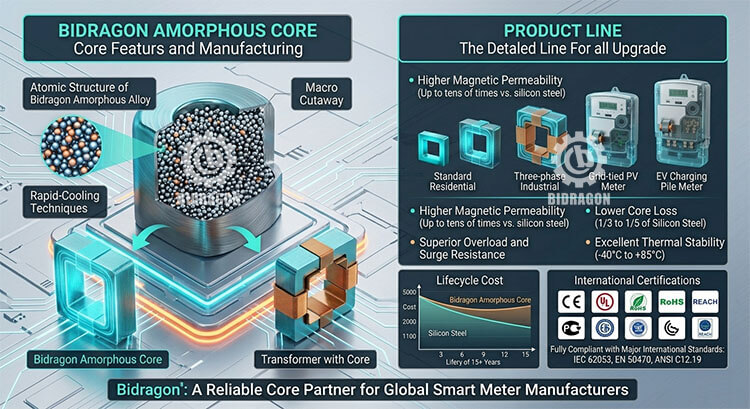
Amorphous alloys are metallic materials produced through rapid-cooling techniques; their atomic structure is disordered—lacking the distinct grain boundaries found in crystalline materials. This unique structural configuration endows them with an initial magnetic permeability that is tens of times higher than that of silicon steel.
This means that amorphous cores are far more sensitive in detecting minute currents. Even under extremely low-load conditions—as low as 0.05% of the rated current or even lower—amorphous cores maintain stable output and excellent linearity. This fundamentally resolves the issue of inaccurate metering at low currents, helping utility companies reduce metering losses associated with low-load conditions by approximately 80%.
This level of high precision is particularly critical in regions that have implemented time-of-use (TOU) pricing schemes and net metering policies. It accurately records a user's electricity consumption during different time periods, as well as the electricity fed into the grid by distributed photovoltaic systems, thereby ensuring fairness in billing.
The core loss of amorphous cores is merely one-third to one-fifth that of traditional silicon steel cores. This characteristic yields two significant benefits.
First, it directly reduces the energy consumption of the electricity meter itself. Although the energy consumption of a single meter may appear negligible, when multiplied by the billions of units deployed worldwide, the cumulative energy savings are substantial. Estimates suggest that if all electricity meters globally were to adopt amorphous cores, over 10 billion kilowatt-hours of electricity could be saved annually.
Second, lower core loss implies that the core generates less heat during operation. This not only extends the service life of other internal electronic components within the meter but—more importantly—enhances the long-term consistency of metering accuracy. Reduced temperature fluctuations lead to minimized variations in magnetic properties, thereby ensuring that the meter's measurement error remains stable throughout its entire operational lifespan.
Amorphous cores feature a steeper magnetization curve, allowing their magnetic permeability to remain at a very high level right up to the point of saturation. This endows them with overload and surge resistance capabilities far superior to those of silicon steel cores.
In regions with relatively fragile power grid infrastructure, this advantage is critical. When the grid experiences instantaneous high currents or lightning-induced surges, amorphous cores are less prone to entering a state of saturation, thereby maintaining their normal metering functionality. This significantly reduces the failure rate of electricity meters and lowers maintenance costs for utility companies.
Furthermore, amorphous cores possess superior interference immunity, effectively suppressing various forms of electromagnetic interference within the power grid to ensure the accuracy of metering data.
Amorphous cores exhibit a higher Curie temperature, and the rate at which their magnetic permeability varies with temperature is significantly lower than that of silicon steel cores. Consequently, they are able to maintain stable magnetic properties across an extremely wide temperature range, spanning from -40°C to +85°C.
Empirical test data indicates that, under identical conditions of temperature fluctuation, the variation in metering error for amorphous cores is approximately one-fifth that of silicon steel cores. This means that electricity meters utilizing amorphous cores can effortlessly adapt to a wide range of climatic environments—from the bitter cold of Northern Europe to the scorching heat of the Middle East—without the need for complex temperature compensation designs.
This holds significant importance for electricity meter manufacturers targeting the global market. A meter design incorporating an amorphous core can be sold across most regions of the world with only minor adjustments, thereby substantially reducing both R&D and inventory costs.
From the very inception of their design, Bidragon's amorphous core products have been targeted at the global market. All our products are rigorously researched, developed, and manufactured in strict accordance with universally recognized international standards, such as IEC 62053, EN 50470, and ANSI C12.19.
We maintain a comprehensive international certification system; our products have successfully obtained numerous certifications—including CE, UL, RoHS, and REACH—enabling them to directly access major global markets such as the EU, North America, and the Asia-Pacific region. Our technical team continuously monitors updates and changes to national standards, proactively building technical reserves to ensure that our customers always have access to products that meet the latest regulatory requirements.
Furthermore, we have established a rigorous, end-to-end quality control system. From the meticulous selection of raw materials to every stage of the production process, and finally to the comprehensive inspection of finished goods, we adhere to standards that exceed industry benchmarks. This commitment ensures that our products maintain a high degree of consistency and reliability, even during large-scale mass production.
Bidragon boasts the industry's most comprehensive product line of amorphous cores, capable of meeting the diverse needs of various smart meter types across different regions of the world.
Our product range covers every application scenario—from single-phase residential meters to three-phase multi-functional industrial meters—and also includes specialized cores tailored for emerging sectors such as grid-tied PV meters and EV charging pile meters. Whether your product targets the high-end European market or is destined for large-scale deployment projects in developing nations, we can provide a proven, corresponding solution.
Our standard amorphous cores feature universal dimensions, ensuring compatibility with the majority of existing smart meter designs. Customers can directly replace their original silicon steel cores without the need for significant structural modifications to the meter, thereby substantially shortening the product upgrade cycle.
We fully recognize that different customers and markets possess unique requirements. Bidragon is backed by a highly experienced R&D team, enabling us to provide our clients with comprehensive, end-to-end customization services.
Whether the requirement involves specific dimensions, unique electrical performance parameters, or optimized designs tailored to a particular application scenario, we are able to respond swiftly—delivering customized solutions to our clients in the shortest possible timeframe. Our customized services extend beyond the products themselves to encompass technical support and joint development initiatives, helping clients resolve the various challenges encountered during the product design and manufacturing processes.
Regarding supply capabilities, we operate state-of-the-art manufacturing facilities in China with an annual production capacity exceeding 500 million amorphous cores. We have established a global logistics and warehousing network, enabling us to provide stable and timely delivery services to clients worldwide. Regardless of your order volume—whether large or small—we guarantee on-time delivery, thereby helping you mitigate inventory-related risks.
For global electricity meter manufacturers and utility companies, the total lifecycle cost of a product is far more critical than its initial purchase price. Although Bidragon's amorphous cores carry a slightly higher upfront cost compared to traditional silicon steel cores, they deliver significant cost savings to clients over the entire product lifecycle.
Electricity meters utilizing our cores feature superior metering accuracy, enhanced long-term stability, and lower failure rates. This translates into fewer on-site calibration and maintenance interventions for utility companies, as well as extended meter replacement cycles—ultimately resulting in substantial reductions in operational costs. For meter manufacturers, this heightened product reliability means fewer post-sales issues and greater customer satisfaction, thereby helping to bolster their brand image and market competitiveness.
We have established long-term, stable cooperative relationships with over 200 smart meter enterprises across more than 30 countries and regions worldwide. Our products operate reliably within power grids across the globe, having successfully withstood the rigorous demands of diverse and complex operating environments.
When selecting a supplier for amorphous magnetic cores, one must look beyond mere price; instead, a comprehensive assessment of multiple factors is required to ensure the products meet the rigorous demands of the global market.
First and foremost, evaluate the supplier's international certifications and compliance with relevant standards. Whether a product has obtained the necessary certifications for target markets—and whether it adheres to local technical standards—is a prerequisite for its successful entry into those markets.
Secondly, consider the long-term consistency and reliability of the product. Core performance should not be judged solely on samples; rather, its stability during large-scale mass production is the true benchmark. A supplier must possess a robust quality control system and mature manufacturing processes capable of guaranteeing consistent performance across every production batch.
Global supply capability is also of paramount importance. The supplier requires sufficient production capacity and a globalized logistics network to meet the delivery requirements of customers across different regions. Furthermore, it is highly advantageous if the supplier maintains localized service teams in key markets to provide timely responses to customer needs regarding technical support and after-sales service.
Proven global application track records serve as the ultimate testament to a supplier's capabilities. Opting for products that have already been widely adopted across various countries and regions can significantly mitigate market risks.
Finally, assess the supplier's R&D prowess and customization capabilities. The global market is characterized by diverse demands; only a supplier backed by strong R&D capabilities can rapidly respond to the unique, personalized requirements of different clients, thereby helping them stand out amidst fierce market competition.
The global energy transition is accelerating, and as the foundational infrastructure of smart grids, smart meters are undergoing technological upgrades at an ever-increasing pace. Future competition within the smart meter market will no longer be a simple price war, but rather a contest of core technologies and supply chain capabilities.
The transition from traditional silicon steel cores to amorphous magnetic cores has become an irreversible global industry trend. This shift not only resolves numerous technical challenges associated with traditional cores but also unlocks greater possibilities for the future evolution of smart meters.
As a leading global manufacturer of amorphous magnetic cores, Bidragon is steadfastly committed to providing customers worldwide with high-quality, highly reliable core products and solutions. We will continue to increase our investment in R&D, constantly enhancing product performance and service standards, and working hand-in-hand with smart meter enterprises across the globe to drive the digital and low-carbon transformation of the global energy sector.
What Is The Difference In Service Life Between Amorphous Magnetic Cores And Silicon Steel Cores?
Under normal operating conditions, the service life of amorphous magnetic cores is significantly longer than that of silicon steel cores. After 5 to 8 years of operation, the magnetic properties of silicon steel cores typically exhibit significant degradation. In contrast, our test data demonstrates that even after 15 years of operation, the magnetic property variation of our amorphous cores remains within 1%. This fully satisfies the service life requirements for electricity meters—15 years in Europe and 20 years in North America.
Which International Standards Do Your Amorphous Cores Comply With?
Our products fully comply with widely recognized international standards such as IEC 62053-21, IEC 62053-23, EN 50470-3, and ANSI C12.19. Furthermore, they have obtained numerous international certifications—including CE, UL, RoHS, and REACH—enabling them to be directly marketed in the vast majority of countries and regions worldwide.
Can You Provide Customized Core Products?
Yes, we possess robust customization capabilities. We can tailor amorphous cores with specific dimensions and electrical performance parameters to meet our customers' precise requirements. Additionally, our R&D team can engage in joint development projects with clients to deliver optimal core solutions for their specific application scenarios.
How Much Higher Is The Cost Of Amorphous Cores Compared To Silicon Steel Cores?
Currently, the initial procurement cost of amorphous cores is approximately 20% to 30% higher than that of silicon steel cores. However, when factoring in the superior metering accuracy, lower failure rates, and extended service life provided by amorphous cores, the total lifecycle cost of the electricity meter is actually reduced by 15% to 25%. For utility companies, the typical return-on-investment period is between 3 and 5 years.
What Is Your Global Delivery Lead Time?
For standard products, we maintain safety stock in our major warehouses worldwide, resulting in a typical lead time of 1 to 2 weeks. For large-volume customized orders, the lead time is generally 4 to 6 weeks. We proactively coordinate production and logistics based on our customers' production schedules to ensure that their manufacturing timelines remain unaffected.